Can You Drive on a Flat Tire? Know When to Stop
Driving on a flat tire can damage the tire and wheel. Learn when to stop, use a spare, request mobile repair or arrange safe roadside help in Oshawa.
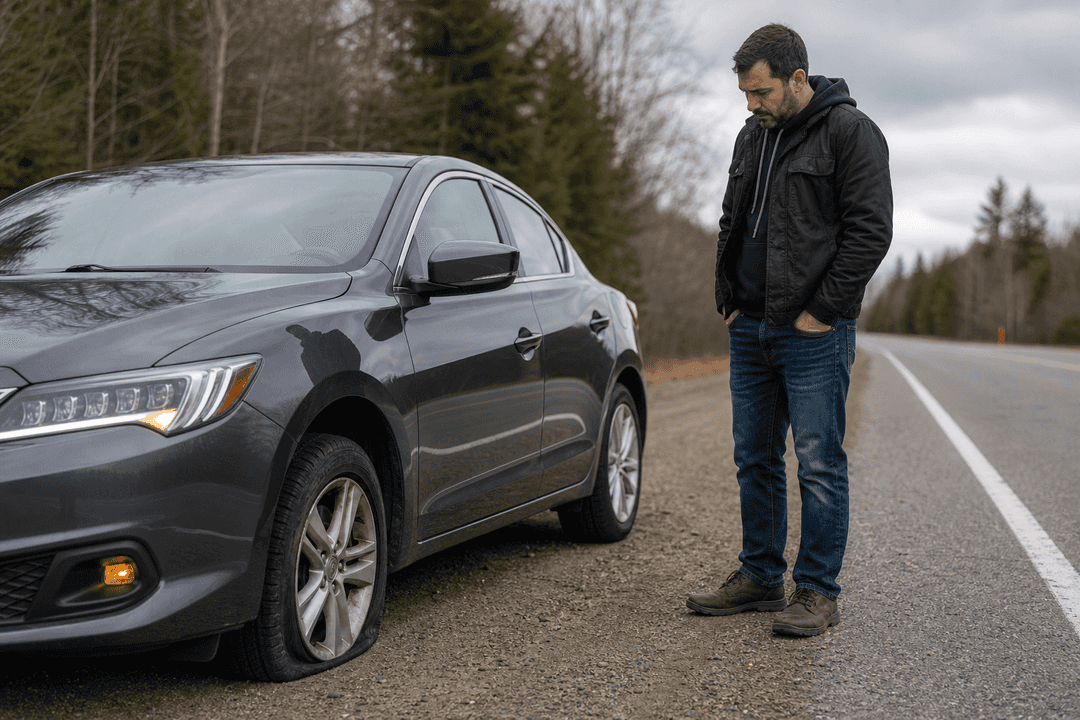
Driving on a flat tire is unsafe for any meaningful distance on a fully deflated conventional tire. Stop safely, avoid sudden braking after a blowout, and arrange a spare, mobile tire assistance or recovery. Run-flat tires are different only within the manufacturer’s stated limits.
The short answer: stop driving on a conventional flat tire
A completely flat conventional tire cannot safely carry the vehicle as designed. Continuing to drive can destroy the tire, damage the wheel and turn a manageable puncture into a more serious repair. Ontario’s Official MTO Driver’s Handbook identifies under-inflated and flat tires as conditions drivers should check before driving. Review the MTO vehicle safety guidance for the official context.
There is no dependable universal distance that is safe on a conventional flat tire. Moving only far enough to leave an immediate hazard may be necessary, but that is an emergency positioning decision, not permission to drive to a shop.
Decide before driving another metre
A completely flat tire means stop and arrange assistance. A slow leak still needs prompt assessment, while a nail or screw does not automatically make continued driving safe.
- Completely flat: Do not drive to a tire shop. Use a suitable spare, request mobile tire help or arrange recovery.
- Rapid deflation, strong vibration or pulling: Reduce speed smoothly and stop in the safest available place.
- Slow leak: Treat it as a developing failure. Pressure can fall further, especially after driving under-inflated.
- Nail or screw in the tread: Do not remove it roadside. It may be slowing the leak, and driving can worsen internal damage.
- Sidewall cut, bulge or visible separation: Do not drive. Sidewall damage generally requires replacement or recovery.
- Run-flat warning: Follow the vehicle or tire manufacturer’s speed and distance limits. Stop sooner if handling changes.
Why distance rules fail, including the “3 tire rule”
The “3 tire rule” is roadside shorthand suggesting that a vehicle can travel because three tires remain inflated. It is not a reliable safety standard. Three inflated tires do not restore the missing tire’s braking, steering, load-carrying or stability function.
Risk changes with speed, distance, vehicle load, road surface, weather, tire construction, remaining pressure and wheel condition. A heavy vehicle carrying passengers or cargo can place greater stress on the damaged corner.
Even a short drive can crush the sidewall, separate internal components or bend the rim. Do not use a kilometre estimate, a “three tire” rule or another driver’s experience as a substitute for an inspection.
What to do immediately after discovering the problem
If a tire blows out while you are moving, keep a firm grip on the steering wheel and do not brake suddenly. The MTO Driver’s Handbook advises using hazard lights and bringing the vehicle to a safe stop off the road when necessary. Read the MTO emergency guidance for a tire blowout.
- Keep control: Hold the steering wheel firmly and ease off the accelerator.
- Reduce speed gradually: Move only far enough to leave a live lane when necessary and safe.
- Use hazard lights: Make the vehicle visible as you move or wait.
- Stop away from traffic when possible: A driveway, parking area or wide shoulder is preferable to a live lane.
- Assess from a safe position: Do not kneel beside a tire on an exposed shoulder or live lane.
- Request the right help: Describe whether the tire is flat, leaking, punctured, separated or attached to a damaged wheel.
Defensive driving can help you recognize developing problems before they become roadside emergencies. These defensive driving techniques offer broader guidance, but no driving technique makes a damaged tire safe to continue using.
Match the tire problem to the safest next action
The visible symptom helps identify the service route, but the tire still needs inspection before repair or replacement is confirmed.
| Situation | Safer next action | What may happen next |
|---|---|---|
| Nail or screw in central tread | Stop if pressure is low or falling. Do not pull it out. | The puncture may be repairable if its location, size and internal condition meet repair requirements. |
| Slow leak with usable pressure | Arrange prompt inspection instead of making a normal trip. | The cause may be a puncture, valve problem, bead leak or wheel issue. |
| Completely deflated tire | Do not drive on it. Use a compatible spare or request mobile assistance. | Repair or replacement may be needed, especially after driving flat. |
| Sidewall cut, bulge or exposed cords | Do not drive. Use a spare or arrange recovery. | Replacement is commonly required because the structural area is compromised. |
| Bent, cracked or damaged wheel | Stop and request assessment. | The wheel may need repair or replacement, and the tire may also be damaged. |
| Run-flat warning | Follow the maker’s speed and distance limits and stop if handling changes. | The tire still needs inspection and is not safe to drive indefinitely. |
What driving on a flat can damage
Without adequate air pressure, the sidewall flexes far more than intended. Heat and repeated flexing can damage the internal casing, bead and inner liner even when the outside looks intact. A puncture that might have been repairable can become unsuitable after being driven without pressure.
The wheel rim can strike the road or deform under the vehicle’s weight. That can create another air leak, affect how a replacement tire seats or require wheel service. Severe instability can also increase the risk of losing control or damaging nearby suspension components.
Choose the right roadside help
Choose the option that addresses both the tire condition and your location. A spare is useful only when it is present, properly inflated, compatible with the vehicle and safe for temporary use.
- Spare installation: Choose this when you have a suitable spare and the vehicle is safely positioned for the change.
- Mobile tire repair: Request this when the tire may have a repairable tread puncture and the vehicle can be safely accessed.
- Mobile tire replacement: Choose this when the tire is destroyed or the damage is outside a repairable area.
- Roadside tire assistance: Request an assessment, spare installation, repair or replacement at home, work or a safe roadside location.
- Recovery: Arrange this when the vehicle is in a live lane, the wheel is badly damaged or the vehicle cannot be safely accessed.
Prepare a useful mobile tire service call
Jang Tire Services identifies phone as the fastest route for urgent vehicle help and supports mobile tire repair and roadside assistance across Oshawa, Durham Region and the eastern GTA. Give the provider enough detail to understand the safety situation before dispatch is discussed.
- Your exact location, cross street, exit number, parking lot or dropped pin.
- Whether the vehicle is in a live lane, on a shoulder, in a driveway or in another safe area.
- The vehicle make and model.
- What happened: blowout, slow leak, nail, screw, sidewall damage, vibration or complete deflation.
- The tire size printed on the sidewall, if you can read it safely.
- Whether a spare, jack and wheel-lock key are available.
Do not stand beside an exposed vehicle while waiting. Remain in the safest available position, keep passengers away from traffic and report any change in the situation.
Questions drivers ask about driving on a flat tire
Can I drive a short distance to a tire shop on a flat tire?
No. A conventional flat tire should not be driven to a shop, even for a short trip, because the distance needed to cause internal tire or wheel damage is unpredictable. Move only as far as necessary to leave an immediate hazard when no safer alternative exists.
What should I do if I have no spare tire?
Leave the flat in place and request mobile tire assistance or recovery. Share your exact location, tire condition, vehicle details and sidewall size if known.
Can a tire with a nail or screw be repaired after driving on it?
Possibly, but the puncture’s location and size, the tire’s internal condition and whether it was driven under-inflated all affect the decision. Stop driving and arrange an inspection.
What should I tell Jang Tire Services when I call from the roadside?
Give Jang Tire Services your location, whether the vehicle is safely off the road, what the tire and vehicle are doing, the vehicle make and model, the tire size if known and whether a spare is available. For urgent help, call (437) 788-3377.
Once safely stopped, Jang Tire Services can assess the appropriate next step for mobile tire repair or roadside assistance. Call Jang Tire Services’ tire services at (437) 788-3377.
- driving
- on
- a
- flat
- tire
Need this done rather than read about?
Jang Mobile Tire Service comes to the vehicle across Oshawa, Durham Region, and the eastern GTA.